I am a very loyal customer. Back when I was new to games I bought Wolfenstein 3-D. They had placed it in a box (Apogee did) and were selling it on retail shelves. Later I bought DOOM through the mail from id Software. I bought DOOM ][: Hell on Earth from the local Babbage’s when it came out. I bought Quake from id Software through the mail again when they released it, and I also bought the two mission packs for it. I’ve bought Quake II, Quake III: Arena and Quake III: Team Arena all on release day. I even bought the re-released Wolfenstein 3-D back in 1998 when Activision shoveled it onto a CD-ROM for the first time.

When I was getting on the Internet by borrowing others AOL accounts I downloaded a warez version of Civilization II since I had read a good review. I liked the game so much I bought it. And later when they came out with the Multiplayer Gold Edition version, I bought that too.

I look back at the last several games I’ve purchased for the PC – Elite Force, Half-Life (Adrenaline Pack), Daikatana, Soldier of Fortune, Alpha Centauri and I realize – they’re all based on engines or from the same people who did the previous games I bought way back in the day. id Software will alwaya be able to sell a buttload of games no matter what, simply because they keep their level of quality up on games and they came out with Wolfenstein and DOOM. I look ahead to the games I’d like to buy next – Return to Castle Wolfenstein and Civilization III – and I realize they’re also derived from the engines/people I’m familiar with.

But does this mean I have no diversity? Does this make me a fanboy? I’ve actually been trying hard over the last few months to go over more games and genres – read about all the games in PC Magazine, not just the ones I’ve heard of.

Part of it is publicity. I’ve made efforts to play Metal Gear Solid and Gran Turismo 2, not because I love those games, but because everyone else does. When tons of people go on and on about a game and it gets amazing reviews from everyone involved, then there may be something to it. I like MGS but when I play GT2 I get the same trepidation I get when I start reading a book that’s over 1000 pages long – I like it but I don’t know if I’ll ever finish it.

Part of it is exposure. I constantly see things on Blue’s News about games with names like Combat, Global Operations, Stealth Combat, Global Ops, Combat Command, etc. It’s hard to tell them all apart. I just gloss over them. However I’ve discovered that when I see footage from a game on a show like Extended Play, suddenly I become more interested in it.

And part of it is just fine – I have no problem with buying a new Nintendo system just to play another Zelda game, no problem with checking out what’s next for Crazy Taxi. A little repetition isn’t neccessarily a bad thing.

Alrightythen – the AIWA CDC-MP3 still kicks ass, but it’s got a few trouble spots. First, when you turn off your car and then start it back up the same song that played when you turned off the car (and thus the stereo) starts to play, but it plays from the beginning – different from the way, say, an audio CD plays. Ergo, if you have Led Zeppelin’s fourth album and you’re playing “Stairway to Heaven”, which runs eight minutes, and every errand you go on takes 7:59 or less to complete, you’ll never get off that track lest you do it manually. The other problem – and this is a bigger one but still not a fatal one – is that the “random” function only works for the directory the MP3 is in – so you can’t shuffle the entire CD. Why this isn’t available as an optional mode is beyond me. Oh well, makes that 11 hour Metallica grandstand occur in the proper order.

Still getting my hands dirty in the Torque engine. Lots of fun.

I think the apocalypse is near – my Mom is on AOL instant messenger now and my Dad is into downloading Bluegrass MP3’s. My freaking parents have Windows XP and a Pentium 4 and I sit writing the next great computer game on a Pentium III 500 with a Voodoo 3 and Windows 98. Actually that’s almost cool – kinda like writing the Great American Novel by using a child’s typewriter that sits on your knees (which is exactly how Stephen King wrote Carrie. Considering my wife has a more powerful system that can’t go more than a few hours without a random blue screen (she needs XP bad) things could be worse.

Oh, and I hear the Doubletree Club Hotel in Houston sucks.

So I got the AIWA CDC-MP3. It kicks ass. It’s got a hell of a lot more power than the little guy that was in the car already (so much so that I had to invest in “speaker savers”) and it of course plays MP3’s. Plus it’s got these cool blue colors happening. The wife and I headed to Whataburger bumping Garbage, Mick Jagger and the KISS box set while we fiddled with the dials and crap. It’s got the whole detachable faceplate dealie and I put it in the case and took it with me to work – not sure how long I’ll continue this practice, but I figured someone might want this thing.

It’s ironic – this MP3 player was the second car deck on the market, after a $750 entry friom Kenwood. This is now the affordable entry. There’s one from Jensen but I’ve been warned away from that brand. There’s also a Sony one that’s more expensive, but this one looked fine. The irony is that Sony stands to lose out on the MP3 deal – they do own a few record labels after all. Then again this is the same mega-conglomerate which put DVD playback in the PlayStation 2, which then went on to compete with Sony DVD players.

MP3 is a “lossy” compression scheme – it obscures or removes the sounds you don’t hear in favor of the ones you do hear. Normal audio CD’s use a lossless scheme – every sample/sound is represented. Picture yourself at a rock concert in the 99th row. What do you hear? The music and crowd noise. Now pretend you’re right in front of the wall of speakers. What do you hear? The music – no crowd noise. The crowd noise is still there – but you can’t hear it, the music is too loud. MP3 in a sense removes the crowd noise. However, if you have, say, the best stereo setup in the world and your ear is trained to hear what others don’t, MP3 sounds awful to you. For the other 99% of us however, it does just fine.

MP3’s been around for a decade now but it didn’t start becoming popular until a utility called AMP in 1997 made it accessible to most people. MP3’s numbers show on average a 90% drop in the amount of data needed to represent an audio track. Whereas an audio CD averages 10MB a minute, MP3 averages 1MB a minute at 128 kbps, 44.1 KHz. Consequently a 700MB CD can hold an average of 11 and 2/3 hours of music – considerably more than the 80 minutes an audio one can hold. The main exploit of the size, of course, has been in the trade of MP3’s online, and the basic invention of music piracy.

MP3 came together more or less in 1998-9 with the convergence of several key technologies, most of which grew completely independently of each other:

  1. Winamp – the Windows port of AMP, it was the first feasible MP3 player for Windows, the most popular operating system. Winamp was small, it was fast (didn’t require too much CPU) and had a ton of features – still adds more every version.
  2. Broadband – back in the 14.4 days it was still a chore to download a megabyte – now it’s a breeze to download hundreds of them.
  3. The CD-ROM Drive – laugh if you will, these things were a rarity when MP3 was unveiled, and ripping a CD directlyis impossible without them.
  4. The large hard drive – hard drives used to be small, now they’re huge. One reason for consumer demand for these things exploded was software bloat (larger versions of Windows, Office) but the other reason was for a place to hold MP3’s.
  5. The CD Burner – now you could turn your MP3 collection into a set of audio or data CD’s. Or both.

And this isn’t taking into account Napster. MP3 was and is complicated, what with FTP rights negotiation and the intelligence factor neccessary to operate all the terms involved – Napster removed a lot of these barriers. Some people were furious over Napster’s introduction because it seemed to bring to the foreground something which had been silently occuring in the underground for some time. However were MP3 never brought into the mainstream we probably wouldn’t have products like we do today.

In late 1998 Diamond Multimedia introduced a player called the Rio (geddit – Diamond Rio?). It had 32MB of memory and it could play MP3’s stored in that space. Instantly the RIAA sued Diamond to take it off the market but Diamond successfully defended the player – noting that there’s nothing to say that people couldn’t use it to play MP3 files of songs they had ripped off of their own CD’s or MP3 files obtained from legal websites. This set a precedent, and soon other MP3 appliances followed. APEX, an obscure DVD player manufacturer whose name came to prominence when it was “discovered” that their DVD player, the AD-600, could do some dodgy things, also had the first MP3 playback capability in a home stereo component. Today hard drive-based MP3 players allow you to take your entire audio collection with you. Coming soon will be CD players with hard drives to rip your entire CD collection onto. And of course Kenwood was the first to have MP3 playback from CD-R’s in automobiles.

I’ve been backing up my MP3’s to CD-R’s for about 2.5 years now – before I even had a burer I finagled others to help me out. Many times I would make a CD of the MP3’s and then make audio CD’s of the albums I downloaded. This meant a lot of CD’s. However I’m glad I backed up the MP3’s now. I even have “themed” CD-R’s – a CD of every Led Zeppelin song ever, one of every Nirvana song, one of all the GWAR material, two of Aerosmith, three of Insane Clown Posse (they’re busy).

In any event, it’s neat to pop in a CD, hit shuffle, and forget about it for 11 hours.

So I’ve listened to the KISS boxed set now and I have to say – I never realized how corny and crappy KISS is. Still I feel compelled to listen to them. Is that wrong?

KISS is of course the same group that was born out of the “glam rock” days that gave us Ziggy Stardust and any number of makeup-clad bands. Coming from Detroit (ironically the same town that gave us makeup-clad rappers Insane Clown Posse) they appealed to both the musical and commercial side of the record industry. When their popularity slumped in the early 80’s they ditched the makeup and outfits and became another 80’s hair band. In the mid 90’s when the hair band bit played out they took a much harder edge, becoming a true heavy metal band. Along the way some of the original members left the group (and one replacement member died of heart cancer), but in 1995 the producers of MTV Unplugged got the original four members back together. The popularity of this event, coupled with a Star Trek-like surge of KISS Conventions prompted the original four members to reunite, put the makeup back on, and do a reunion tour and album, Psycho Circus.

A short while back I heard KISS was hanging it up soon and I thought how sad that was – that I never got to see them in concert. Not that I like KISS or ever really did – I just figured a KISS concert was something you were “supposed” to do (like how you’re “supposed” to go see certian movies). I got over that as soon as I saw a very blantant PEPSI ad with them singinging on stage about PEPSI with that little girl from the PEPSI ads in KISS makeup and I decided they couldn’t break up fast enough for me. However I have since amended my position – KISS was always about marketing. Witness all the crap they’ve released over the years. Today some parents think video games are evil, how in the hell was there a market for a KISS Lunchbox? In any event, I’ll just settle for the DVD of Detroit Rock City – it’s even got a KISS commentary track!

But yeah KISS is pretty much responsible, it turns out, for most of the “bad 80’s” songs I’ve ever heard. I recall back in the early 90’s I went through a phase where I wanted to get all the vinyl records I could. Of course by then vinyl records were all but extinct (same story these days), so on one trip to an out of town mall I settled on the one record I could find – a copy of Kiss My Ass, a KISS tribute album. As it turns out there have been a few of these. I remember hearing the covered versions of KISS tunes by Lenny Kravitz, The Mighty Mighty Bosstones and even Garth Brooks and thinking to myself these were harmless songs. But then I remembered how I recently saw a video for the much harder song “Unholy” and thinking to myself that I must be mistaken – the same group that did “Christine Sixteen” couldn’t have done that song – but sure enough the last track on this red vinyl disc was a German cover of “Unholy” – truly KISS was a band with an identity crisis.

Then there was the aforementioned video game – owing more or less nothing to KISS but that’s OK – KISS doesn’t owe much to themselves anyways, apparently. Kinda like a Final Fantasy movie which has nothing to do with the Final Fantasy games, it’s acceptable since the Final Fantasy games have mostly nothing to do with each other.

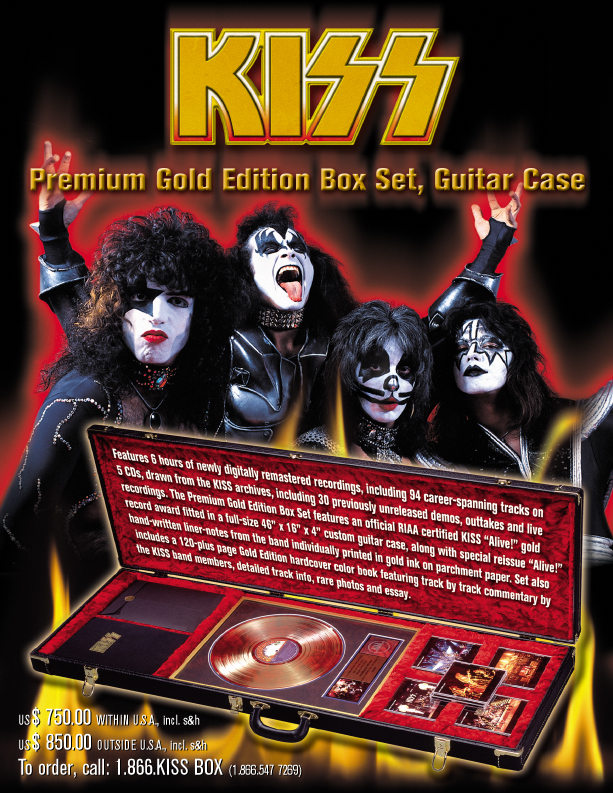
In any event now we have a KISS boxed set. I just figured with the number of greatest hits compilations (seven or so) KISS has released over the years, this would be another rehashing. And I was sorta right. As it turns out KISS fans have fantasized over the years over a boxed set – one that would define KISS’ career (which surely defied definition). It comes in at least three different configurations, each of which has the same exact five CD’s and the same book. One comes in a standard box for $75, one of which comes in a mini guitar case for $195, and one of which comes in a full sized case complete with gold album for $750. Surely if the fans want to get hosed they can get hosed as much or as little as they want.

Boxed sets are tricky affairs. On the one hand they have to be an all-encompassing retrospective of a band’s career. It helps, to this end, if the career is finished. On the other hand, it has to go comb the vaults for rare and unreleased stuff, since the hardcore fans demand and deserve it. The hardcore fans of course already have all the albums from which this material has been culled, so you have to put unreleased material to appease them. The conundrum of the boxed set is that they are habitually low sellers. The best selling boxed set of all time is the first Led Zeppelin boxed set at six million copies – after that boxed sets drop off dramatically. On the one hand you have to focus on general greatest hits to appeal to the casual fan who is probably picking up the set because they’ve never purchased an album from the artist in question. However, if the artist is popular enough to demand a boxed set in the first place, then how many fans of this type could possibly be out there? (Bear in mind we’re eliminating the “casual” boxed sets – the “we did a concert and here’s a video and CD in a box” sets.) For that matter the casual fans will just go to one of the dozen or so greatest hits albums you’ve released. So the hardcore fans are the target audience, so it makes sense to include more of the unreleased stuff than the set. But this is another stumbling point – usually unreleased material consists of things like demo tapes or songs that were never finished. For these reasons these items are usually not in the best repair – recording conditions for four guys in a garage are never as good as in a studio. Some of the tracks on this KISS set are in near-unlistenable condition. The casual fans who would buy a set soley of this would probably take it back. A proper balance of these sorts of elements are what the art of the Boxed Set consists of. The KISS boxed set does a decent job at it.

Hopefully by the end of this week I’ll get my MP3 CD in my Car on…

I forgot to mention it but Tuesday it was announced that Next Generation magazine was going away. There’s really only two magazines I subscribe to these days, and PC Gamer was the other one. The reason was said to be the fact that the magazine was no longer profitable, its subscription base having dwindled to 110,000 from its peak in 1996 (it launched in 1995).

So now I’m stuck, so to speak. I still love PC Gamer and of course PC Gaming, but now I don’t know how to handle the non-PC side of gaming. Imagine, the publisher, still has the Official XBox Magazine which is all well and good but I don’t own an XBox, plus I think it’s another one of those dealies where the magazine is adamantly pro-XBox and anti-everything else. This is fun so long as you agree with it. There’s an Official PlayStation Magazine from Ziff-Davis, but I’ve read a few issues and it’s not so good. Nintendo has of course always published Nintendo Power, but that’s more of a Propoganda Rag than anything else. Imagine pulled the plug on their own Official Dreamcast Magazine which was a fine publication while it lasted so it bodes well for the OXBM, but like I said – I don’t own one of those yet. As for platform agnostic publications like GamePro (which I’ve started recieving in the mail, presumably in lieu of ODCM), they’re also like extended fluff ads – nothing but reviews and previews. No insight, no articles on the industry, just hype and fluff.

Next Generation started out with brilliant writing, but I noticed how the size of the issues dwindled over the years. They still had badass articles, but as the people changed over the years the qualitiy did decline. Part of the reason the later issues were less exciting is because since the start of the mag in 1995 the industry expanded to an $8 Billion a year endeavor. Consoles win for political reasons now, instead of “who’s got the better games?”. It was more fun when someone crazy like a 3D0 or an Atari could still try to make a console – now there’s a huge barrier to entry (it’s taking MS between $1 and $2 billion to make XBox a hit). Plus Next Generation more or less completely neglected the PC over the last year and a half as we saw four consoles launched (and only three survive). Ironically in the first few issues of the magazine there was a series of articles called “What’s Wrong with the PC?”. In the time being we saw the introduction of the Quake trilogy, EverQuest and a ton of other hot PC games. In the last year or so the console hype buried the PC again. This is cyclical – when the new consoles are coming the PC fades into the background and people wonder if it’s dead. When the consoles all come out the PC rises into prominence again (how else could you properly get your Civilization on?) and it’s hailed as the best game machine again.

Still, Next Generation was the first to report the existence and the code (and real) name of Microsoft’s XBox project, they regularly provided insight into the workings of the industry, and they had badass articles to the end. They were the first games magazine aimed at the intelligent adult instead of the child. It’s going to suck to see them go.

So I’m now officially on the lookout for a new platform agnostic magazine. To be honest I really haven’t even bothered to look before. I know there’s Electronic Gaming Monthly and Computer Gaming Monthly and they were alright last time I looked, but I don’t really know what else there is. Sad thing is, I’m almost tempted to take up IGN on their Insider offer. Sure, it’s mostly web based with a PDF magazine, but there is a print version available as well and IGN is pretty good, truth be told. Plus it would be nice to have access to all those web pages before others. But there’s something genruine about having magazines on your shelf – there’s something soul-less about having to pay just to view a web page that will go away someday. Plus there’s no way in hell I’m printing out those PDF files.

If you guys (all four of you) have any insight on the platform agnostic print magazine or have any suggestions, drop me a line.

I could just write my own magazine but, nah……

So – there’s this old console called the Intellivision. It’s significant since it was a popular console in its day and was a worthy competitor to the Atari 2600. It’s also significant for the manner in which the old games are being handled these days.

The method in which games and publishing are handled today is somewhat reverse in progression from that of, say, the music industry. In the music industry the individually created works gave rise to the notion of the product works. Groups like The Beatles came up with all their own stuff to try and get a record contract whereas the Backstreet Boys never met each other prior to being “cast” in the part. The game industry worked just the opposite – whereas today an independent development entity like an id Software will conjure up a game and then sell it to a publisher (though they now of course have nice comfy contracts) originally the game industry was all about making products.

Remember that prior to 1961’s Spacewar! there was no such thing as a video game. And remember that no one made a dime off of a game prior to 1972’s Pong. Ergo, there was no industry to speak of for some time. Atari made their 2600 console and Atari made the games for it – case closed. Part of the reason that no one else made 2600 games was due to the fact that no one else had knowledge of the inner workings of the system – it was the first popular console with interchangeable cartridges and reverse engineered development software and EEPROM burners were a ways off. The other part – the big part – was simply that it hadn’t occured to anyone to do so. Atari made the console and the games simply because that’s how it happened.

Mattel then decided to get into the game industry, along with some others. It seemed like a good idea – first you sell them a game console, which was pretty much a toy anyway, and then you sell them the games. And they can keep getting the games. It was like selling a Barbie doll and then selling all the little accessories – except that the accessories were more profitable in this case, and more neccessary.

Problem was they had no one to make the games – as in program them. Whereas any goofball can think up Barbie accessories, programming, especially in the early 1980’s, was something rare, especially because the game industry – indeed the entire notion of the video game – was so new. Mattel’s answer? Hire up a bunch of kids right out of college, stick them in a room, have them whip up a bunch of games. You won’t have to pay them too much – these were kids right out of college after all – and back then there wasn’t much precedent on how games were made. Some games were licensed – like the port of Donkey Kong they had secured the rights to from Nintendo (who also decided to have a go at this market a little later on) and they had secured the rights to make games based on TRON, including hiring the guy who came up with the concepts for the games in that movie. Many of the ideas were cooked up in committee and simply handed to the programmers. In these cases the programmers would try all sorts of means to get their ideas worked into the game (usualy telling the non-techie bosses that such-and-such was “impossible” and then telling them what would work) but in other cases the programmers could simply conjure up whatever game they wanted. This is when video games were such low tech affairs that one person could do all the art, sound and programming themselves. The people who did these games for Mattel dubbed themselves the Blue Sky Rangers.

But they weren’t allowed to put their names in the game. Not on the cartridges, not in the manual, nowhere. You don’t know who made the Barbie Dream House and you wouldn’t know who programmed Astrosmash. Atari had this policy as well and it served as the tip of the iceberg for a set of programmers in their fold to pack up and leave. They went off to form Activision and publish games like Pitfall and River Raid, always making sure to credit the author(s) on the box, much like a book (i.e., Pitfall – by David Crane). Activision was the first ever third party publisher. Atari sued them, but they didn’t have a leg to stand on. This was before the days of licensing – no one had to pay Atari anything to develop for the 2600. Nothing in the 2600 was patented, it was all using off the shelf technology. When this legal precedent was set, it also paved the way for 2600 clones and adapters for other systems.

This was also long before the days of quality control, such as a game having to pass Sony or Nintendo’s approval process. In 1982, the bottom fell out of the industry for various reasons – little innovation, too many crappy games, fads wearing off, etc. Mattel’s Intellivision survived the crash, but only briefly. The planned new Intellivision was shelved and all the Blue Sky Rangers were laid off. The Intellivision concept was sold to a new company calling themselves INTV, Inc. and that company survived until 1990. Intellivision was pretty much dead at that point until the Web came along. In 1995, when a Blue Sky Rangers website showed up a large number of people started to want to play the old Intellivision games again, so BSR pooled money together to buy the rights to the old games again.

The result of this was the 1998 CD-ROM Intellivision Lives!. Containing a comprehensive encyclopiedia of the Intellivision and its games, along with an emulator and the ROM images for over 50 games, it sold in fairly large numbers to video gaming’s elite and became a must have for the hardcore gamer (naturally I bought one).

Some games couldn’t be released or included – the games dealing with licnsed properties like TRON or AD&D couldn’t be included, nor could any of the later games which Activision developed (after donning a multiconsole srategy). Included however were some games which never saw release, such as an excellent pool game called Deep Pockets, which had probably the most advanced programming on the Intellivision.

The follow-up CD-ROM, Intellivision Rocks!, was planned for release more than a year ago but the Website has been silent. This led some to believe that the disc had been cancelled. However just last month Intellivision Productions (the name of the new production company) announced that they had inked a deal with Motorola to bring Intellivision games to cell phones. This is something of a new trend now – since cell phone technology is advancing but still nowhere near the level needed for, say, modern 3-D games, they’re perfect for old games. The first title to be available will be Astrosmash. And now the Intellivision Rocks! CD-ROM is available for purchase.

Old games never die – they just find new places to live.

One of the things I’m fasinated about learning about is how an industry, especially one like the Game Industry works. I know the basics – you pay $40 for a game and $17-18 makes its way to the publisher – but the little intricacies fascinate me. There are two particular instances that get me.

The first instance was exemplified by the Circuit City ad I saw Sunday. I see that there’s a new PlayStation game out. It’s called Blaster Master: Blasting Again. It’s a 3-D sequel to the old NES game Blaster Master – you know, the one with the little kid with the tank that can jump into the air. Okay, that looks kinda neat and it’s interesting that it finally came out, especially since I saw this one last previewed over a year ago. I had just assumed it had come out or that it had been canceled. However, it was just recently released and – get this – Circuit City was selling it for $4.99. That’s not all – it retails for $9.99. They never intended this game to sell for more than ten bucks.

Now part of me assumued it must be a horrible game – Daikatana went through a similar fate, being the rare FPS debuting at $29.99 and quickly dropping down in price ($4.99 currently). However the other part of me wanted to buy it – if it sucks I’m only out five bucks.

Now here’s the real hell of it – I go to see what sort of “scene” there is for Blaster Master – every old game pretty much has a small “scene” behind it, with one or two pages being the “definitive” page for it. I found the Blaster Master Underground. This guy has been following everything surrounding Blaster Master for a while now. The last report he had on Blasting Again was back in September, when it looked like the financial status of the developer was going to keep the game from hitting U.S. shores. The only way this guy found out about the game being released was when people emailed him to tell him it was in Target. There was no press release, no pre-release reviews, no nothing. The only way anyoune found out about this game was when stores started carrying it. In the industry this is referred to as “sneaking it out the door”.

Sometimes this is for good cause – Take Two snuck the Dreamcast port of KISS: Psycho Circus: The Nightmare Child out the door after reviews of the PC game labeled it a bland title with no innovation and they didn’t want to waste their time conjuring up a multiplayer mode for the game. Supposedly the original reason for sitting on Blaster Master last year was because of the hype surrounding the PS2. Why then release it? And at such a small price? Last year we started to see the beginnings of the $10 PSX game – but most of them were just further discounted Greatest Hits titles or crap games from budget publishers – the game industry equivalent of a pulp fiction or romance novel publisher. So was this also a crap game?

Well luck had it that Circuit City had a very affordable fax machine, something my wife has wanted for some time now, so we went to go get it and I sort of threw the Blaster Master game into the mix, much like a congressman pork barrelling a small act for his hometown on some legislation that will surely pass. I’ve only played it for a short time (no PSX memory card) and I can say this – for $5 this game ain’t half bad. It’s not going to take on Metal Gear Solid but it works.

The second phonomenon that fasicnates me, though it’s a little more believeable, is when a game is cancelled for publication at the last minute. The best example of this is the Dreamcast port of Half-Life, which Sierra had Gearbox Studios port for them. This game even had review copies distributed to reviewers. It had been bandied about back and forth – the biggest question being whether or not to include online multiplayer. It was decided to separate the game into two separate staggered relesases – one with single player only and the second with multiplayer only. Sierra even went forward with the release after Sega announced in January that they would be abandoning the Dreamcast. However, quite literally at the last minute Sierra cancelled the game by announcing it on a forum somewhere (a full press release later followed). The reason was understanable, if a little friustrating – they figured the game wouldn’t sell well since the Dreamcast had stagnated and was essentially an abandoned platform, and they didn’t want to lose any more money printing millions of copies and not selling most of them. They were willing to accept the loss of the costs involved in developing the port, but no further losses. It didn’t help that this all happened during the Tribes 2 fiasco. Gearbox then turned its energies to the PlayStation 2 port of Half-Life, which was just released.

But what’s even more fascinating is when the game itself still winds up in the hands of the public, albeit in an unauthorized fashion. When Virgin Interactive was purchased by Electronic Arts, EA did what all good mergers do – they went through and cut some of the projects in production, to make the company they just bought more efficient. Part of the 10% killed was a game called Thrill Kill. A figthing game that was designed to be ultra-violent for violence’s sake, it was first to be cancelled if for no other reason than it would probably be a huge liability (yet more parent’s group protests). However somehow an ISO disc image of the game made its way to the Internet and the game is an underground classic. Kemco secured the rights to code and publish Daikatana on the Nintendo 64 and Game Boy Color. The GBC version actually follows the events, levels and story of the PC game as closely as a Zelda wannabe game could. However, while ROM images for various versions of the game have been on the Internet for some time now, I have no evidence the game was ever released. It was never at any game store I was at and it was never on Gamestop.com, EBGames.com or Amazon.com. I think it was quietly canceled. How people got ahold of ROM images is beyond me (though I can guess it may have been released in other countries). The Nintendo 64 game was another “constructed from scratch” port which was originally only released to Blockbuster for rentals. This was something the Nintendo 64 saw a lot of towards the end. The publishers liked it because it meant that they were guaranteed to sell the copies they made – all of which were sold to Blockbuster. Blockbuster liked it because then they had an exclusive game. Some games released in this fashion went on to see retail release if they rented well – a way to “test the waters” so to speak. Daikatana 64 went on to make a limited retailer run.

In any event, I’m off to go listen to the KISS boxed set.